2025
Winter Driving Guide for Newcomers
Civic Emergencies Project
Skills
Project Management, Strategic Planning, Design Research, and Design Evaluation through Prototyping and User Testing
Tools
Adobe Illustrator, Adobe InDesign and Figma

Goal
For this capstone project, apply the knowledge and skills acquired in earlier Information Design coursework to design a solution specific to a civic project topic such as municipal service requests (311 app), municipal wayfinding, or municipal emergencies. From the chosen topic, develop a project plan and implement your design process to create the final solution.
Project Overview
A civic‑focused capstone project examining how newcomers can better prepare for Calgary’s winter road conditions. Through research, prototyping, and user testing, I developed a Winter Driving Guide designed to reduce anxiety, improve preparedness, and support municipal emergency response efforts.
The deliverables of this project included the following: a project proposal, final solution (Case Study), Winter Driving Guide, presentation and showcase.
Process
Research Phase
To begin understanding the problem and needs of the users, I conducted desk research and interviews with Calgary residents who had varying levels of winter driving experience.
From the desk research, I was able to break the issue into 3 main components:
Calgary Driving Scene
Winter-related car accidents and stress on emergency services
Limited Resources
Lack of effective communication on safe winter driving practices
Impact on Drivers
Driver’s anxiety and lack of confidence
Having a better understanding of the problem, I interviewed 7 people with varying levels of winter driving experience and one new Calgary resident. The insights gathered varied widely from winter driving advice, fears, expectations and more. These helped define the needs of the audience and gave insight into what should be included in this information package.
Experienced Drivers
-
Slow, controlled movements and increased following distance
-
Practice in low‑risk environments (empty parking lots, driving courses)
-
Learned from real incidents, either witnessed or experienced
-
Check road conditions via Calgary Traffic / 511 Alberta
-
Carry essential tools (scraper, shovel, cardboard) + use winter tires
Inexperienced Drivers
-
Basic driving knowledge but uncertain how to adjust for winter conditions
-
Anxiety around slipping or getting stuck
-
Need guidance on appropriate speeds, car settings, winter tire basics
-
Want to observe experienced drivers to build confidence
New Calgary Resident
-
No prior snow-driving experience
-
Knows “slow down + brake early,” but needs emergency guidance
-
Would seek info from government sites, insurance, or locals
-
Wants to practice with an experienced driver
Synthesis Phase
To get a more comprehensive understanding of what content should be included in the package, I conducted a sample analysis. The sample included 10 online resources on winter driving ranging from governmental websites from other municipalities, online forums, and more.
Sample Content Organization

Synthesis
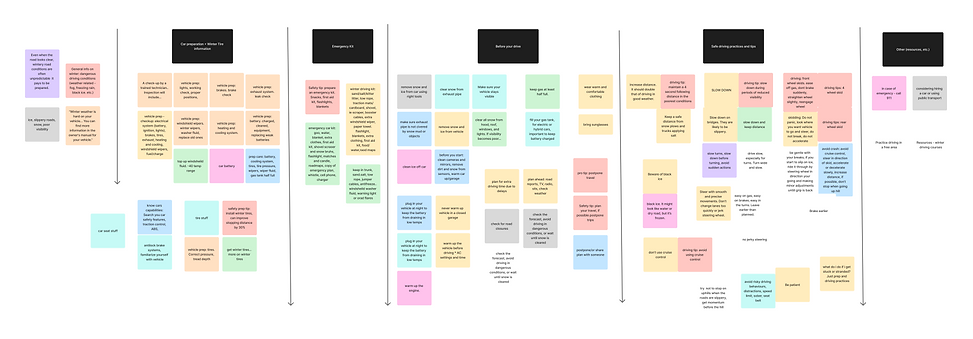
Based on the sample analysis and interviews, I was able to make the basic content structure of the winter driving guide.
Content Stucture

Prototype & Test Phase
For the first prototype, I tested it for clarity, content organization, usefulness, and information retention.
First Prototype (few pages)

From user testing with 3 people, I was able to gather insights that would help the further development of the prototype.
User Test Insights
Clarity & Organization
Content was easy to understand and sections were intuitive to navigate.
Visual Design
Users wanted more instructional visuals (symbols, diagrams) but not decorative elements.
Relevance & Usefulness
The guide covered essential topics but could include more newcomer‑specific context and links to additional resources.
Final Solution (Second Prototype)


To view the full Winter Driving Guide, click here: Winter Driving Guide for Newcomers
Theoretical Grounding
In regard to the theoretical grounding surrounding the effectiveness of the solution, I chose 3 cognition biases that reflect key UX principles and bias effects reflected in the guide book.
Cognition Biases - Theoretical Grounding
Chunking
Organizing content into clear sections improves processing and retention.
Example: tabbed sections, page headers, content hierarchy, and whitespace
Level of Processing Effect
Information is remembered more easily when it’s meaningful to the user.
Example: content addresses major concerns and information relevant to circumstances, and intentional seeking of new information
Serial Position Effect
People remember the first and last items best.
Example: Information can be viewed in any order the reader chooses through easy-to-navigate section tabs. This stimulates memory and improves retention.
Future Considerations
With this second and final prototype, I was able to conduct another user test. Overall, they thought the booklet was clean, easy to navigate, and easy to understand with the supporting visuals. However, to make it an even more effective solution for the audience, there are a few ways to take the design further.
Consulting Experts
Consult driving instructors to validate accuracy and expand guidance.
Accessibility
Offer a web‑based version and translations for newcomers with diverse language needs.
Distribution Strategy
Provide the guide through registries, municipal offices, and newcomer welcome packages.
The considerations above represent the potential areas that could make a more effective solution.